
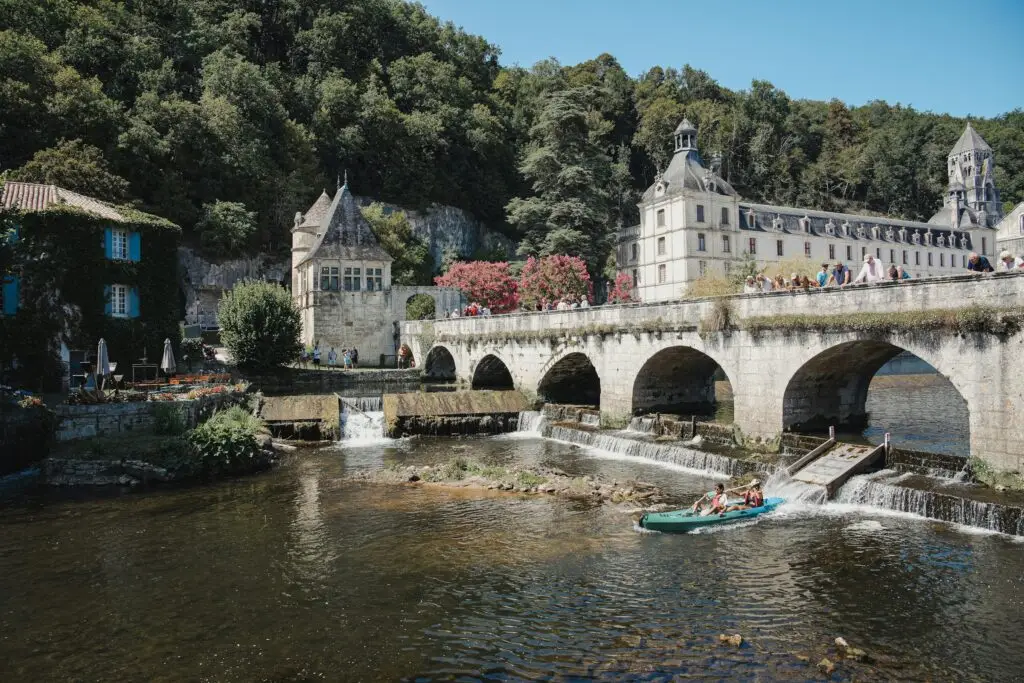
Brantôme (“where?” I hear you say) is a lovely model village that sits in the Périgord Vert (“ok, well now he’s just making words up”) which is in Dordogne in southwest France, about twenty minutes north of Périgueux (“we should probably do a welfare check on him. He’s clearly just stringing weird letters together”). Stick with me, here’s my mini guide to Brantôme
Affiliate Disclosure
This post doesn’t actually contain affiliate links. If you book through them, I won’t earn a penny. They are my gift to you 
About Brantôme
 I’d read on the internet that Brantôme was pretty before I got there. What I hadn’t appreciated was quite how beautiful and charming this place is. The River Dronne literally wraps itself around the village, with the old town sitting on its own little island. That means you’re never more than a minute or two from a stone bridge, a weir, a family of fat juicy ducks swimming about, or something ivy-clad, stoney and medieval reflected in the languidly slow running water.
Someone, at some point, decided to call it the Venice of Périgord (“you. It was you, wasn’t it?”), and for once the comparison is almost deserved.
More than just the Abbey
 The town’s centrepiece is its Benedictine abbey, rumoured (with the usual sprinkle of tourist-board legend) to have been founded by Charlemagne in 769. Behind it are the steep granite cliffs, into which generations of monks carved shelters and chapels directly into the rock. There’s even a grotto with a weathered Last Judgement scene that’s been unsettling visitors (“you know what’s unsettling? This guide is”) for the better part of a millennium. It’s must be one of the oldest monastic sites in France, and it certainly looks the part.
Beyond the abbey, Brantôme is a pretty French village that rewards the solo traveller who enjoys a leisurely walk along a lazy river, a potter about a local market, and a slow lunch built around the region’s delicious produce. Think foie gras, walnuts, the odd truffle if you’re there in season, and the occasional unlucky juicy duck that didn’t manage to swim away quite fast enough.
Yes, it’s small enough to see in a day, but why rush? I’d argue it’s better used as an excuse park up, stay a couple of nights, and soak in the calmness of French village life. Of if you’ve packed your bikini, even enjoying a paddle at the small beach in the heart of town just by the main car park. (“This is getting ridiculous. He’s drunk, isn’t he?”)
Brantôme Practical Info
Getting to Brantôme
Nearest airports are Bordeaux-Mérignac (about 1.5 hours by car) and Bergerac (around 45 minutes drive). Brantôme itself has no train station, so a car is the easiest way to get around, because public transport in this part of the Dordogne is limited.
Best time to visit Brantôme
Spring and early autumn for the mild weather, fewer crowds, and the leafy French countryside round here at its best. Summer can be very warm and August is particularly busy with French tourists (there’s a popular caravan park in the town centre, so expect families) especially when the Friday market is on.
Is Brantôme suitable for solo travellers:
Definitely yes. The village is very safe to walk around, and there’s plenty to do and see to keep yourself as busy as you want to be. There’s also enough coffee shops, picnic spots and riverside bars to spend hours if you’d rather not.
Guide to where to stay in Brantôme
 Moulin de l’Abbaye. A 4 star luxury hotel on the banks of the river, with its own Michelin-starred fine dining restaurant. This place tends to bet booked up quickly, so reserve your room early
- Click here to book directly on Moulin de l’Abbaye website
- Click here to find Le Moulin de l’Abbaye on Google Maps
 Hotel Charbonnel. On the edge of the old town and located overlooking the main bridge over the River Dronne, this 3 star hotel has its own terrace right on the riverside.
The hotel restaurant does an exceptionally good-value and delicious prix-fixe at lunch (with extra optional caviar which I can recommend if it’s your birthday.)
- Click here to book directly on Hotel Charbonnel website
- Click here to find Hotel Charbonnel on Google Maps
 Moulin de Roc. A 10 minute drive (watch out for speed cameras! I got caught twice) outside of Brantome. this converted mill is simply stunning. Pet friendly, and with sustainability at its heart, there are only 15 rooms each decorated in period furniture. There’s a large swimming pool in the grounds if you’re feeling sporty, and a fabulous restaurant (with seriously impressive wine list) if you’re a normal person.
Guide to what to eat & drink in Brantôme
Périgord is a foodie heaven. Unless you’re on a diet. Or a vegetarian.
Foie gras
- Popular with vegans the world over (!!) yet banned in many countries because of animal cruelty, foie gras is the fatty liver of a goose or duck that has been fed using the questionable method of gavage and is a delicacy in France.
- It is a specialty of the Aquitaine region (which includes Périgord).
- Foie gras season runs from March to September, although it is available at other times. Peak time of year for fresh foie gras is November to December when traditional fat duck and goose markets open across Périgord and Dordogne
Duck
- Duck is deservedly popular in many local restaurants, and makes an appearance on most menus
- Dont miss out on trying both duck breast (magret) and duck confit (confit de canard)
- Restaurant La Guinguette is particularly well-known for serving delicious plates of duck, but best book in advance
Truffles
- I love truffles, but I appreciate they might not be everyone’s cup of tea. Also, they’re not lookers TBH.
- Truffle season runs from mid November through to March. The whole Périgord region is knee-deep in expensive fungi, with the local black truffle being at its peak from December to February.
- During this time expect pretty much everything you order in a restaurant to come with the offer of an extra truffle shave.
- To avoid stinking up your luggage, and mashing your credit card up, I’d advise not buying actual truffles to take home with you. Instead, purchase a small bottle of locally produced truffle oil.
Guide to what to do in Brantôme
 Visit Brantôme Abbey
Brantôme Abbey was (allegedly) built back in the 8th century, and rebuilt in the 15th century following the Hundred Years’ War and the annexation of Aquitaine by France. It was listed as a historic monument in 1840.
The bell tower of the Abbey church dates back to some time in the 12th century. One of the oldest bell towers in France, weirdly it’s in its own building separate from the main church.
Behind the church are the chambers and grottos that monks carved directly into the limestone cliff before the stone abbey structures were built. You can even check out the salmon farm that they’re now running in there.
 Book a kayaking trip
If you’re sporty, looking for adventure, or just like dressing up in nylon waterproofs and crash helmet during the day (“what?? Now he’s just being weird“) then squeezing yourself into one of the kayaks that pootle along the river is for you. And if you get as far as the weir, do take care not to get stuck, unless you want to end up featured in every tourist’s Intagram photos about their day in Brantôme.
Lose yourself in hidden riverside garden
Wander down Rue Victor Hugo in the old town and you’ll spot a number of bars, restaurants and coffee shops with rear gardens that face the river. Pop into any of these with a good book, and lose yourself for a few hours. You’ll thank me for it later
Picture credits:
- Main photo by Jacques Dillies on Unsplash
- Moulin de l’Abbeye photo by Didier VEILLON on Unsplash